
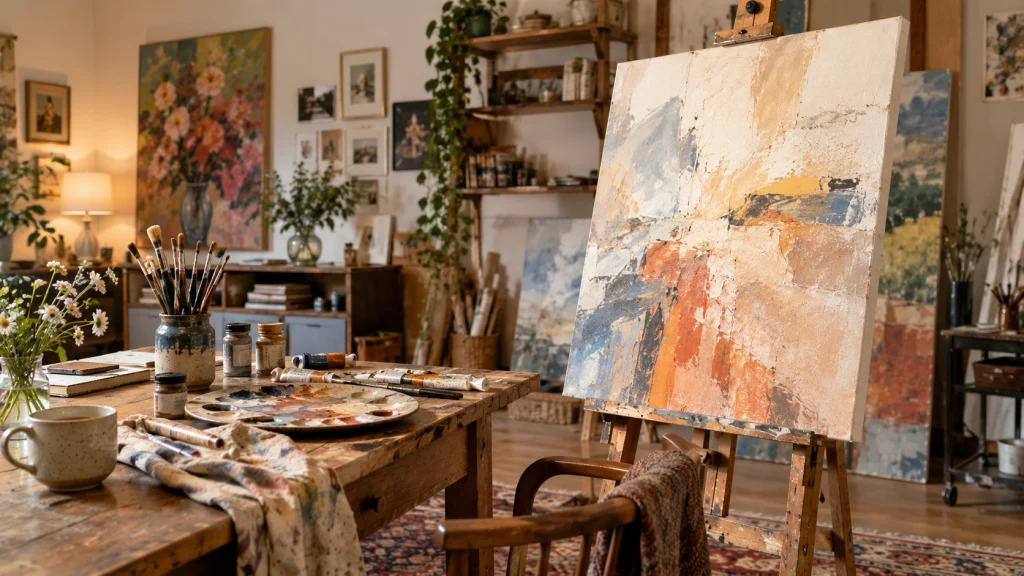
Understanding the ideas behind abstract art, why it moves us, and what makes a painting more than a collection of colours and shapes.
Have you ever stood in front of a painting and found yourself looking at it longer than you expected, even though you could not immediately recognise what it was depicting? A deep blue area might sit beside a tangle of black lines, a sudden flash of orange, or shapes that seem to float without belonging to any familiar scene. You look again, trying to make sense of what you see. Sometimes, the feeling arrives before you can put it into words.
This is one of the fascinating qualities of abstract painting. Rather than relying entirely on recognisable subjects or a clearly defined narrative, it draws our attention to the visual elements themselves: colour, line, shape, space, texture, movement and the relationships between them.
Yet abstract art is often misunderstood. Some people find it difficult to approach because it offers no obvious subject to identify; others assume that putting a few colours on a canvas is enough to make a successful abstract painting. Neither response captures the range of thought, experimentation and artistic decision-making that abstraction can involve.
A painting may appear spontaneous, yet even a seemingly simple composition can involve difficult choices. How much colour is enough? Where should a line stop? Should one shape dominate the others, or should the entire surface hold our attention? How might a colour that seems calming on its own become unsettling when placed beside another?
To understand abstract painting, we need to look beyond what a painting represents and consider how its visual elements work together—and how those relationships shape our experience of the work.
What Is Abstract Painting?
Abstract painting is an approach to art in which the artist simplifies, transforms or moves away from the direct representation of the visible world. Rather than depending entirely on recognisable subjects, an abstract painter may use colour, shape, line, gesture, pattern and texture to construct a visual composition.
However, abstract art is not necessarily disconnected from the world around us.
An artist might begin with a landscape, a face, a flower or an everyday object, gradually simplifying or distorting its forms until the original subject becomes less recognisable. Other artists create compositions from geometric shapes, colour relationships and gestural marks without referring to any specific object. Both approaches belong to the broad field of abstraction.
The terms abstract, non-representational and non-objective are closely related, although they are not always used in precisely the same way. Abstract art can retain traces of recognisable subjects, whereas non-representational and non-objective art generally place greater emphasis on visual elements without depicting identifiable objects or scenes. In practice, these terms sometimes overlap, particularly in general discussions of modern art.
These distinctions help explain why abstract painting cannot be reduced to a single style. A carefully structured composition of rectangles and straight lines offers a very different visual experience from a painting built through sweeping brushstrokes, layered colours and expressive gestures. Both can be abstract, yet their methods, intentions and visual effects may differ considerably.
The National Galleries of Scotland’s introduction to abstract art provides a useful starting point for exploring these different approaches.
How Abstract Painting Changed the History of Art
For centuries, much Western academic painting placed considerable importance on representing the human figure, religious narratives, historical events, landscapes and everyday life. Artists developed sophisticated methods of drawing, perspective, modelling, colour and composition to create convincing images of the visible world.
Abstraction did not emerge because artists suddenly forgot how to represent things. It developed through a broader transformation in modern art, as painters began questioning whether a picture had to imitate the visible world to communicate something meaningful.
Photography, new artistic movements, changing ideas about perception and spirituality, and wider cultural changes all contributed to this transformation. There was no single event or individual responsible for the emergence of abstract painting; it developed through several overlapping experiments and artistic ideas.
In the late nineteenth and early twentieth centuries, artists increasingly explored ways to simplify, distort or move beyond recognisable subject matter. By the early twentieth century, some were creating paintings in which colour, line and form became central in their own right.
Wassily Kandinsky became one of the best-known pioneers of abstraction. His ideas about the expressive and spiritual possibilities of colour and form were influenced, among other things, by his interest in music. He explored how a painting could communicate through visual relationships rather than depending entirely on the depiction of external objects.
Kazimir Malevich pursued a different direction. Through Suprematism, he explored geometric forms and colour as fundamental elements of painting. Piet Mondrian developed an increasingly reduced visual language based on straight lines, rectangular forms and carefully organised areas of colour. Their approaches were not interchangeable: each grew from different artistic and philosophical concerns.
The history is also incomplete without Hilma af Klint, whose series of abstract works began in 1906. Drawing on spiritual ideas as well as her artistic training, she developed a distinctive visual language that included geometric forms, symbolic imagery and bold areas of colour. Much of this work remained largely unseen by the public for decades, and her contribution has received renewed attention through scholarship and major museum exhibitions.
After the Second World War, Abstract Expressionism emerged as a major movement in the United States. Its artists explored gesture, scale, material and colour in varied ways. Jackson Pollock became associated with drip painting, while Mark Rothko developed expansive fields of colour that invite sustained, contemplative looking. Helen Frankenthaler experimented with staining unprimed canvas, a technique that helped influence the development of colour-field painting.
These artists did not share one universal theory of abstraction. Their differences are precisely what make its history worth studying.
For a deeper historical introduction, see the Guggenheim Museum Bilbao’s overview of abstraction in art and the Museum of Modern Art’s guide to Abstract Expressionism.
The Elements That Give an Abstract Painting Its Character
If a painting does not depend on a recognisable subject, what holds it together? The answer often lies in how its visual elements interact.
1. Colour: More Than a Choice of Pretty Shades
Colour is one of the most immediate ways an abstract painting captures our attention. A field of muted blue may appear quiet beside warm beige, while the same blue can feel much more intense next to bright orange.
But colour does not carry one fixed emotional meaning.
Red is often associated with energy, warmth, danger or passion, yet its effect depends on context. Blue can suggest distance or calm, but it can also feel cold, heavy or oppressive. Yellow may appear joyful in one composition and harsh in another.
These associations can be influenced by culture, personal experience, surrounding colours, lighting and the particular qualities of the painting. They are possibilities rather than universal responses.
Artists also work with relationships between hues, values and saturation. Hue refers to a colour’s basic identity, such as blue, red or yellow. Value describes how light or dark it appears, while saturation refers to its intensity or vividness. A composition containing several bright colours may feel lively, but a carefully controlled arrangement of muted colours can be just as compelling.
Consider a painting built from dusty rose, warm cream, dark brown and a small amount of deep blue. The blue might become the point that attracts the eye, not because it occupies the largest area, but because it contrasts with the surrounding palette.
The question is not simply which colours look beautiful together. It is what each colour contributes to the whole.
2. Line: The Direction of the Eye
Lines can divide a surface, connect shapes, establish boundaries or guide the viewer’s gaze. Their character changes according to their direction, thickness, length, rhythm and manner of application.
A series of horizontal lines may suggest stability or stillness. Sharp diagonals can introduce tension or a sense of movement. Curving lines may create a flowing rhythm, while broken or jagged marks can interrupt it.
These are possibilities, not universal rules. A horizontal line can feel unsettling if it sits in an unexpected position or is interrupted by a forceful diagonal. Its effect depends on the surrounding elements and the way the composition is organised.
The way a line is made also matters. A thin, deliberate line differs from a thick mark created with a loaded brush. A scratched line through wet paint reveals something different from a line carefully drawn over a dry surface.
In abstract painting, a line is not merely an outline around something else. It can become an essential element in its own right, directing attention, creating rhythm or introducing tension into the composition.
3. Shape and Form: The Architecture of the Painting
Shapes give a composition structure. They may be geometric, such as circles, squares and triangles, or organic, with irregular contours that suggest natural growth or movement.
A geometric composition may feel orderly when its forms are clearly defined and arranged according to a system. Organic shapes can appear more fluid or unpredictable. Yet a painter can deliberately disrupt either effect, creating irregularity within a geometric arrangement or imposing a sense of order on organic forms.
Imagine placing one large, irregular dark shape in the lower corner of a pale canvas. Add two small circles near the opposite edge and a narrow line that draws the eye between them. Suddenly, the canvas has a relationship between visual weight, distance and direction.
Nothing needs to resemble a person, building or landscape for the composition to have structure.
It is also useful to distinguish between shape and form. Shape generally refers to a two-dimensional area, while form often refers to three-dimensional volume or the illusion of volume. In painting, the term form can also be used more broadly when discussing how visual elements are organised, so its precise meaning depends on the context.
4. Texture: What the Surface Contributes
Texture can be actual or visual.
Actual, or physical, texture exists in the material surface. Thick paint, raised marks, rough canvas, scraped layers and other material treatments can create a surface that has a tangible physical quality.
Visual texture is the appearance of texture. A painter may suggest roughness, softness, grain or movement through brushwork, colour and mark-making, even when the surface remains relatively smooth.
Texture can change how we experience colour and shape. A flat, even area of paint may feel different from a similar colour applied in thick, uneven strokes. Scraping away a layer can reveal traces of an earlier decision, making the history of the painting visible.
This is one reason photographs do not always communicate the full experience of an abstract painting. A reproduction may show the composition clearly while losing some of the physical depth, surface variation and subtle changes in light that can be seen when viewing the original work.
5. Space: What Happens Between the Marks
Space is not simply the empty part of a canvas. It actively shapes the relationships between the elements that occupy it.
A large unpainted area can give a small shape room to breathe. Closely packed marks may create density or pressure. A form positioned near the edge can make a composition feel open, unbalanced or deliberately off-centre.
Artists can also create the illusion of depth through overlapping forms, differences in scale, colour contrasts and other visual cues. Alternatively, they may emphasise the flatness of the canvas rather than suggesting a world extending behind its surface.
Negative space—the area around and between forms—is especially important. Removing a mark or leaving an area untouched can sometimes strengthen a composition more than adding another layer of paint.
Each of these elements can contribute something to a painting, but none works entirely on its own. Colour changes in relation to neighbouring colours; a line gains character from the shapes around it; and an empty area can become just as important as a heavily painted one. The larger question is how an artist brings these elements together into a composition that feels intentional.
Composition: Why Some Abstract Paintings Feel Complete
A painting can contain beautiful colours, interesting textures and expressive marks yet still feel unresolved. This is where composition becomes important.
Composition is the organisation of visual elements into a whole. It involves decisions about placement, scale, contrast, rhythm, balance, repetition and the distribution of visual weight.
Balance does not necessarily mean symmetry. A large, dark shape on one side of a painting might be balanced by several smaller, lighter forms on the other. The result may feel stable, energetic or deliberately off-centre, depending on how the elements relate to one another.
Contrast helps create emphasis. Repetition establishes rhythm, while variation prevents repetition from becoming monotonous. Unity allows different elements to feel connected, and differences between them keep the composition visually interesting.
These principles are not a checklist that every abstract painter must follow in the same way. Artists can deliberately disrupt balance, introduce tension or leave a composition open-ended if that serves their purpose. Some decisions emerge through careful planning; others develop through experimentation, intuition or unexpected results. What matters is how these choices contribute to the painting as a whole.
A useful exercise is to look at an abstract painting from across the room and notice where your eye goes first. Then look again from closer up. Does your attention move around the canvas? Is there one dominant area, or do several areas compete? Do the quieter sections support the stronger ones? Does the arrangement draw you in, create tension or leave you uncertain about where to look?
Such questions help us move beyond simply liking or disliking a painting and begin to understand how it has been constructed—and why its arrangement may affect us in a particular way.
Emotion in Abstract Art: Why a Painting Can Feel Like Something
One of the most compelling qualities of abstract painting is its ability to explore emotion without relying on a literal narrative.
An artist may be interested in grief, excitement, uncertainty, tenderness, isolation or renewal. Instead of depicting a person experiencing these feelings, the artist can explore them through contrasts, gestures, colour relationships, scale and rhythm.
A crowded arrangement of dark marks may create a sense of pressure. A broad, quiet field of colour may encourage contemplation. A sudden interruption in an otherwise orderly composition can introduce tension or make the painting feel unsettled.
But we should be careful about assuming that a particular visual element always produces a particular emotion.
The artist’s intention and the viewer’s response may differ. A painting created during a period of sadness may appear peaceful to someone else. A composition intended to communicate freedom might remind another viewer of disorder.
Neither response automatically invalidates the experience.
Abstract art leaves room for personal associations because it does not always supply a specific story. A viewer may connect a colour with a childhood memory, a shape with a place they once visited, or a pattern with the rhythm of music. Someone else may respond to the same painting primarily through its formal qualities: the arrangement of shapes, the movement of lines or the relationships between colours.
This openness does not mean that an abstract painting can mean absolutely anything. Its colours, materials, structure, title, historical context and the artist’s statements can all inform interpretation. Personal responses become more interesting when they engage with what is actually present in the work.
A thoughtful viewer can ask two questions together: What do I feel when I look at this painting? And what is it about the painting that might be contributing to that feeling?
The second question takes the experience further. It connects an emotional response to the choices, relationships and details that make the painting what it is.
Is Abstract Painting Just Random Marks on a Canvas?
This question deserves a fair answer.
Some abstract paintings are created through spontaneous gestures, improvisation or processes that deliberately welcome chance. Others emerge through planning, sketches, repeated revisions, careful measurement and precise control. Many combine these approaches.
Jackson Pollock’s drip paintings are a useful example. Their surfaces may appear chaotic at first, but the process involved physical movement, experimentation and decisions about how paint was applied across the canvas. The resulting patterns developed through an interplay of intention, bodily movement and chance. The Museum of Modern Art’s discussion of the processes and materials of Abstract Expressionist painting offers further context for understanding these experimental methods.
Spontaneity itself can be a deliberate artistic method. So can repetition, restriction and precision.
An artist might limit a painting to three colours, use only straight lines, work within a strict geometric structure or allow each layer to dry before making the next decision. Another might respond to the movement of the hand, the behaviour of wet paint or an unexpected result when materials interact.
There is no single correct method.
However, the freedom to experiment does not mean that every result will be equally successful. An artist can make something intentionally loose and expressive while still considering whether the marks create the desired effect. A painter may also decide that an apparently awkward passage is essential to the work, even if it does not conform to conventional ideas of beauty or balance.
The point is not that abstract painting must look complicated or technically polished. It is that its decisions, processes and visual relationships can be explored, questioned and developed. Chance can contribute to a painting, but what the artist chooses to do with an unexpected result can be just as important as the result itself.
Different Approaches to Abstract Painting
Abstract painting encompasses many styles. The categories below offer useful starting points, although they are not rigid divisions, and artists often move between them.
Geometric abstraction uses clearly defined shapes, lines and organised arrangements. It may explore proportion, order, repetition, colour relationships or visual systems. Piet Mondrian’s mature abstract paintings are an important historical reference, with their carefully arranged lines and rectangular areas of colour.
Gestural abstraction places emphasis on the movement and physical action of painting. Brushstrokes, sweeping lines, splashes and other marks can record the artist’s interaction with the surface. Gestural approaches are associated with parts of Abstract Expressionism, although artists within the movement worked in different ways.
Colour-field painting focuses on expansive areas of colour and the relationships between them. Rather than relying on a busy arrangement of forms, a work may invite sustained attention to subtle shifts in colour, scale and atmosphere. Mark Rothko and Helen Frankenthaler are important artists to explore in this context, although their methods differed considerably.
Lyrical or organic abstraction often features flowing shapes, irregular forms and fluid arrangements that evoke movement or growth without necessarily depicting identifiable objects. The term covers a range of artistic approaches rather than one universally defined movement.
Textural and layered abstraction draws attention to the physical qualities of paint and the history of the surface. Scraping, glazing, layering, staining and variations in application can create visual depth and complexity.
These approaches can overlap. A painter might combine geometric forms with loose gestures or introduce heavily textured passages into an otherwise restrained colour-field composition. Instead of trying to fit every work into a single category, it is more useful to examine how the artist has used materials, colour, shape and technique to achieve a particular effect.
How to Look at an Abstract Painting Without Feeling That You Must Understand It
Not every painting reveals its qualities immediately, and different viewers may respond to the same work in completely different ways. That is a normal part of experiencing art.
You do not need a formal art education to look carefully. Begin by noticing your initial response. Does the painting attract you, unsettle you, bore you or make you curious? There is no need to label that reaction as right or wrong.
Next, pay attention to the visual elements. Which colours dominate? Are the shapes precise or irregular? Do the marks appear soft, forceful, repeated or broken? Is the surface smooth, layered or heavily textured?
Then consider the composition. Where does your attention go first? What happens when you focus on the quieter parts of the canvas? Does the arrangement feel balanced, tense, open or crowded?
Give yourself time to look again. An area that seemed unimportant at first may become more interesting once you notice how it relates to the rest of the work. You might also discover a contrast, a repeated shape or a subtle change in colour that escaped your attention initially.
If the artist has given the work a title, read it. Information about its historical movement, background or place within a series can offer another perspective. Such context can deepen your understanding, but you do not have to uncover a single hidden message to appreciate what you see.
Looking carefully is not the same as solving a puzzle. You can respond to a painting before you fully understand how it was made, and your interpretation can develop as you spend more time with it.
Can Anyone Learn to Paint Abstract Art?
Anyone can begin exploring abstract painting, although developing an individual artistic practice takes time, observation and experimentation.
A background in drawing or painting can be helpful, but it is not a prerequisite for getting started. Understanding colour, composition, materials and visual balance can support the process, and these skills grow through practice.
One simple exercise is to choose three colours and a neutral shade, then create a small composition using only lines, shapes and areas of colour. You might begin with an idea of how you want the work to feel—calm, energetic, balanced or unsettled. Let that intention guide you, while remaining open to unexpected results.
Next, make another painting using the same palette but a different arrangement. Change the scale of the shapes, leave more negative space or introduce a contrasting mark. Comparing the two works can reveal how seemingly small decisions influence the character of a composition.
You can also draw inspiration from observation without trying to paint a recognisable subject. Notice the shadows cast on a wall, the movement of branches, reflections in water or the changing colours of an evening sky. Reduce these observations to a few lines, shapes or colour relationships instead of reproducing the scene literally.
The aim is not to imitate a famous abstract artist or create something that looks expensive enough to hang on a wall. It is to discover how visual decisions influence a composition and gradually recognise which approaches appeal to you.
Your first painting may feel awkward. The next might seem too crowded, while another may surprise you in a way you never anticipated. Each attempt offers an opportunity to notice something new, whether it is a colour combination that works, a mark that changes the entire composition or an area that becomes stronger when left untouched.
Progress does not always mean producing a more polished painting. Sometimes, it means understanding your own choices a little better.
When Does an Abstract Painting Feel Finished?
There is no universal formula for knowing when a canvas is complete, but artists often reach a point where additional marks no longer strengthen the composition.
Sometimes another layer or a stronger contrast brings the elements into better relationship. On other occasions, a distracting mark needs to be removed or covered. A piece can also lose its impact through repeated additions, especially when the original relationships between colour, shape and space begin to disappear.
Stepping away from the canvas can help. Viewing it from a distance, turning it around, taking a photograph or returning to it after a break may reveal problems that were difficult to notice while working up close.
It is also useful to identify the strongest quality in the composition. Is it the relationship between two colours? The movement of a particular line? The balance between a large shape and an empty area? Recognising what gives the image its character can make it easier to decide what should change—and what deserves to remain untouched.
Finishing does not necessarily mean resolving every tension. Some abstract paintings depend on uncertainty, contrast or a deliberate sense of incompleteness. The important question is whether the elements have reached a convincing relationship within the particular piece, rather than whether anything more could possibly be added.
Abstract Painting Is Not About Escaping Meaning
It is tempting to think that abstract art becomes meaningful simply because viewers can project their own feelings onto it. Personal interpretation is part of the experience, but it is only one part of the story.
Abstract painting can explore perception, spirituality, politics, identity, movement, order, chance and the nature of painting itself. An artist might respond to a particular historical moment, investigate a philosophical idea or explore the expressive possibilities of a material.
Others begin without a clearly defined message and discover the direction of a composition as it develops.
Meaning can emerge through the interplay of artistic intention, process, visual structure, historical context and the viewer’s experience. It does not always arrive as a sentence that can be neatly summarised.
This is one reason two abstract paintings that look superficially similar may be doing very different things. One might explore carefully controlled geometric relationships, while another uses comparable shapes to question order or introduce tension. Visual appearance offers a starting point, but it does not always tell the whole story.
To appreciate abstraction is to remain curious about what a painting does, how it was made and what becomes possible when representing recognisable subjects is no longer the primary purpose.
The Beauty of Leaving Something Open
One of the most rewarding qualities of abstract painting is its ability to offer an experience without explaining it completely.
A painting may remind us of something we cannot name. It may create a mood that changes as we spend more time with it. Its colours might draw us in, its structure hold our attention, or its unexpected details leave us wondering what we have just experienced.
That uncertainty does not have to mean a failure of understanding.
Art can be precise without being literal. It can be carefully constructed without appearing controlled. It can move us without depicting an emotional scene, leaving questions unanswered while still offering a rich visual experience.
For anyone returning to painting after years away, this openness offers an inviting place to begin. There is no need to produce a masterpiece, develop a signature style immediately or know in advance what every mark will mean. Start by observing, experimenting and learning to notice visual relationships that might previously have gone overlooked.
With time, you may discover that abstract painting is about much more than putting colour on a surface. It involves making choices, noticing how those choices affect the whole and gradually developing a visual language of your own. Sometimes, a painting does not need to tell us exactly what to feel. It only needs to give us a reason to look a little longer.
Further Reading: Museum and Art-History Resources
For readers who want to explore abstract painting in greater depth, these museum resources offer reliable starting points:
- National Galleries of Scotland — Abstract Art: An introduction to abstraction, its visual characteristics and its development in modern art.
- Guggenheim Museum Bilbao — Abstraction in Art: Historical context for the development of abstract approaches.
- The Museum of Modern Art (MoMA) — Abstract Expressionism: An overview of the movement and its varied artistic approaches.
- MoMA — The Processes and Materials of Abstract Expressionist Painting: An exploration of gesture, materials and the physical process of painting.
- Guggenheim — Hilma af Klint: Paintings for the Future: Background on af Klint’s pioneering abstract paintings and their spiritual influences.
- Guggenheim — Kandinsky Gallery: An overview of Kandinsky’s artistic development and his contribution to abstraction.
These resources provide a foundation for further study. The interpretations and practical reflections throughout this article are intended to encourage closer looking, not to prescribe a single correct reading of every abstract painting.