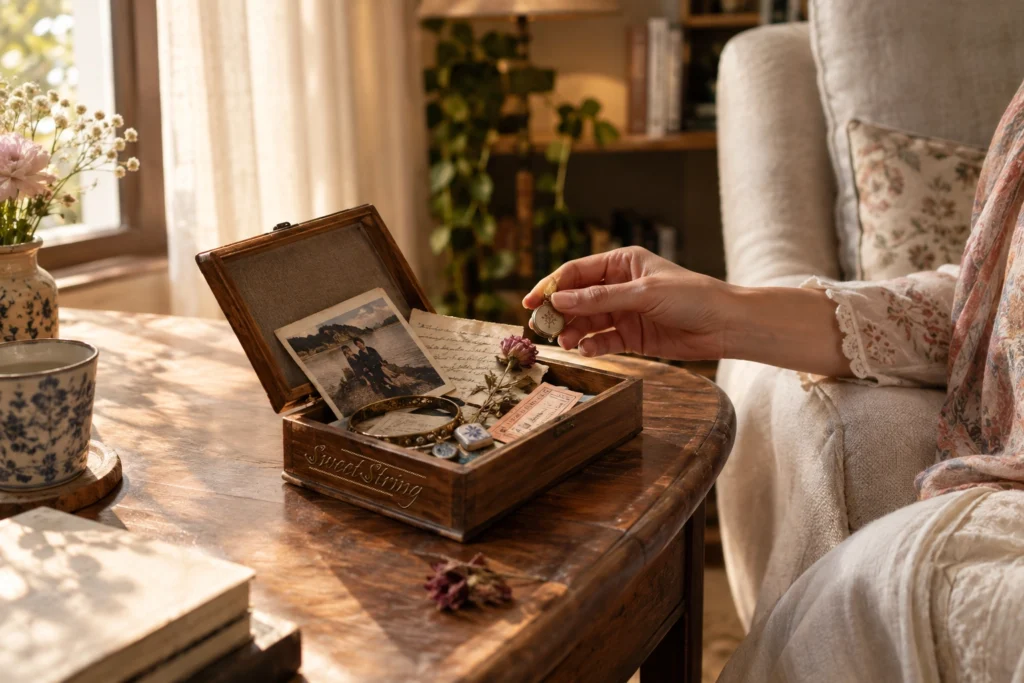
There are things in our homes that haven’t been useful for years. We don’t wear them, read them, use them, or even remember they’re there until we happen to open an old drawer, move a box, or clean a shelf. And then we find one—an old birthday card, a bracelet with a broken clasp, a movie ticket, a dried flower, a photograph that’s beginning to fade, or perhaps something so ordinary that nobody else would understand why we kept it.
Someone else might look at it and think, Why are you still keeping this?
And strangely, we may not have a very good answer.
We just know that throwing it away doesn’t feel right.
That little reaction is more interesting than it seems. If something hasn’t been useful for years, why can it still feel important? Why can we easily let go of ten other things but hesitate over one tiny object that has almost no practical value?
Perhaps because we aren’t always keeping the thing itself. Sometimes, we’re keeping what the thing represents.
When an ordinary object becomes something more
Most objects enter our lives for practical reasons. We buy a mug because we need a mug. We buy a dress because we like it. We keep a ticket because we need it to get somewhere. A photograph is taken because we want to capture a moment.
But somewhere along the way, an object can stop being merely an object.
A bracelet might become connected to the person who gave it to us. A handwritten recipe can become connected to someone whose cooking we remember. An old notebook might remind us of the person we were when we filled its pages. A little souvenir from a trip can bring back an afternoon we haven’t thought about in years.
The physical object hasn’t become more valuable in any measurable sense. Its emotional meaning has changed.
It has become attached to a story.
This is one reason sentimental objects can be so difficult to explain to someone else. They can see a faded photograph, while we see the people in it, the place where it was taken, the age we were, the clothes we wore, and perhaps even the feeling of that particular day. They see a piece of paper. We see a memory that happens to have a physical form.
In that sense, some objects almost become little time machines. We don’t need to look at them every day for them to matter. Their presence alone can make us feel that a certain part of our life hasn’t completely disappeared.
We don’t only keep memories of other people
It’s easy to assume that sentimental objects are mostly about people we love, but sometimes the person we’re holding onto is ourselves.
Think about the things you once owned during a completely different chapter of your life. Perhaps there is an old outfit you haven’t worn in years, books from a subject you no longer study, a notebook filled with plans you never followed, or something you bought when you had a very different idea of where your life was going.
You may have no practical reason to keep any of it.
Yet getting rid of it can feel surprisingly final.
That’s because objects can remind us of versions of ourselves that no longer exist in quite the same way. They can take us back to the person who had those ambitions, those friendships, those routines, those worries, or those dreams.
Growing older often means leaving pieces of ourselves behind without noticing that we’re doing it. We change our priorities, our relationships, our tastes, our homes, our careers and sometimes even our understanding of what we want from life. An old object can quietly remind us that the person we are today wasn’t always the person we were.
And perhaps we don’t want to erase that earlier version of ourselves simply because we’ve moved on.
Sometimes an old thing is proof that we were once there.
The strange comfort of keeping something from the past
Not every object we keep brings back a happy memory. Some carry complicated feelings.
There may be a letter from someone we no longer speak to, something belonging to a person we’ve lost, or an object from a period of life that was difficult but important. We might not want to return to that time, yet we still aren’t ready to remove every trace of it.
That doesn’t necessarily mean we’re stuck in the past.
There is a difference between remembering something and wanting it back.
We can know that a relationship is over and still treasure what it once meant. We can be grateful for a chapter of our life without wanting to live it again. We can keep a photograph of someone without wishing that time could return.
Sometimes an object gives us a way to acknowledge the past without reopening it.
It sits quietly in a drawer, a cupboard, or a box while life continues around it.
And perhaps that’s part of the comfort. We don’t have to think about the memory every day. We simply know that if we ever want to visit it, the little doorway is still there.
Why other people don’t understand our “important” things
One of the most fascinating things about sentimental objects is how personal their value can be.
You might show someone a small object you’ve kept for years and expect them to immediately understand why it matters. Instead, they look at it and ask, “What are you going to do with that?”
The honest answer might be: nothing.
And that’s exactly the point.
The object doesn’t have to do anything anymore.
Its usefulness ended a long time ago. Its meaning didn’t.
A stranger might see a broken watch. You remember who wore it. Someone else might see an old postcard. You remember the trip, the weather, the hotel room, or the person who sent it. Someone might see a child’s drawing that belongs in the recycling bin. A parent may see a tiny piece of a childhood that has already gone.
This is why sentimental value is so difficult to measure. It doesn’t depend on price, rarity, beauty, or usefulness. Something worth almost nothing to one person can be irreplaceable to another.
The story is invisible unless you know it.
But sometimes we keep things for simpler reasons
Of course, we shouldn’t turn every forgotten object into a profound emotional symbol.
Sometimes we keep things because we think we’ll need them one day. Sometimes we paid good money for them and don’t like the idea of wasting them. Sometimes we’re simply too tired to make another decision about what stays and what goes.
And sometimes, quite honestly, we just keep putting it off.
There is also something psychologically uncomfortable about making an irreversible decision. Putting something back in a drawer leaves the possibility that we might need it someday. Throwing it away closes that possibility.
So the drawer wins.
But even objects that began with no emotional importance can acquire it over time. After sitting with us through several homes, several years, or several stages of life, they become part of our surroundings and, in a small way, part of our history.
We remember where we found them. We remember when we bought them. We remember the home we had when we first used them.
Their story grows simply because they stayed.
Maybe usefulness isn’t the only kind of value
We’re often encouraged to judge the things around us by whether they are useful.
Do you use it?
Do you need it?
Does it serve a purpose?
Those are perfectly sensible questions, especially when we’re trying to make a home easier to live in. But human beings have never valued things purely for their practical function.
We keep photographs that cannot do anything for us. We save letters we could easily replace with a digital copy. We hold onto objects that would have very little monetary value if they were sold.
Because some things serve a different purpose.
They help us remember.
They remind us where we’ve been, who we’ve loved, what we’ve survived, and sometimes who we used to be. They give physical form to experiences that otherwise exist only in our memories.
That’s why the word useless can sometimes be misleading.
An object can be useless in the practical sense and still be meaningful in the emotional one.
The object may be ordinary. The memory isn’t.
Perhaps that’s why the things we keep for years are not always the beautiful things.
Sometimes they’re scratched, faded, slightly broken, outdated, or completely unremarkable. They may not look like keepsakes at all.
But we know their story.
We know why that particular mug has survived several kitchen clean-outs. We know why an old card is still tucked inside a book. We know why we couldn’t throw away that photograph. We know why a tiny object that nobody else would notice has somehow followed us through different rooms, different homes, and different years.
Its value isn’t sitting on its surface.
It’s somewhere inside our history.
And maybe that’s the real reason we keep things we never use again. Not because every old object needs to be preserved forever, and not because letting go is always wrong, but because usefulness isn’t the only way something can matter.
Some things stop being possessions and quietly become pieces of our story.
Maybe that’s why we pause before throwing them away.
Maybe that’s why we put them back in the drawer.
And maybe, sometimes, that’s okay.